The answer they read matches the commit you merged.
I built this for people who already write MDX in git. Hosted is $0. MIT if I disappear.
Blode.mdLast updated
Git-native docs hosts added a web editor that commits back to the repo, plus a marketplace. If you want that, that product exists.
If you want a CMS, this is the wrong tool. You're not looking for a second review flow.
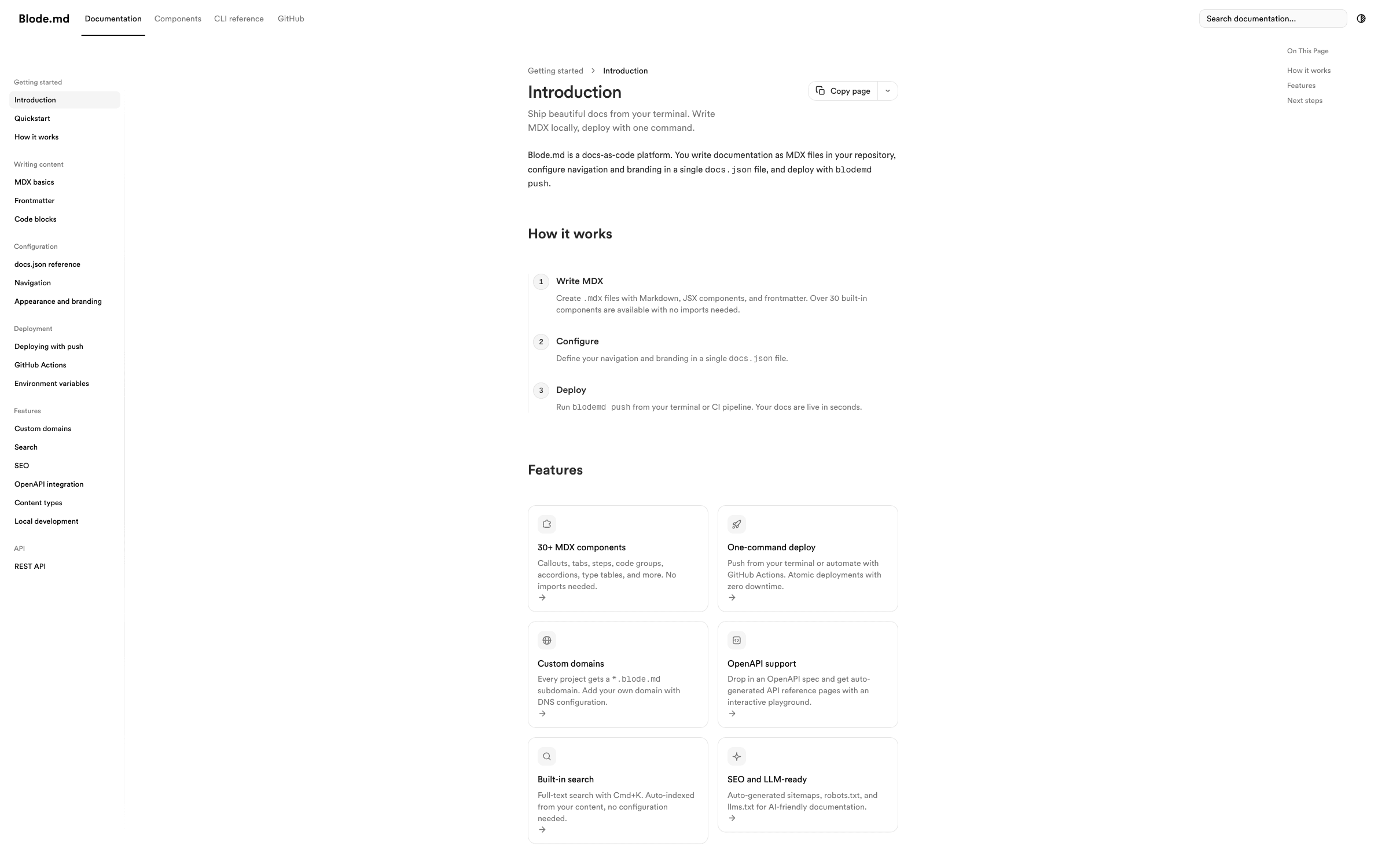
Write MDX in the repo. The pull request is the review. The merge publishes the site, including the Markdown agents fetch from that commit.
What's inside
The merge is the deploy
Sign in with GitHub and push. You do not run Docusaurus, a search index, or a custom-domain pipeline to get a public URL.
# install the CLI
$ npm i -g blodemd
# browser sign-in with GitHub
$ blodemd login
# scaffold from your project root
$ blodemd new docs
# ship it
$ blodemd push docs
Deployed to acme.blode.md
02
Markdown from that commit
llms.txt, llms-full.txt, and per-page .md exports are written from the same MDX as the HTML. Agents fetch those files instead of scraping a stale page.
03
On the domain they already trust
Proxy /docs through the site you already run. Paste-ready configs for Vercel, Cloudflare, Nginx, and Caddy live in the guides, not as a second product.
04
MIT if I disappear
Same CLI and renderer, your Postgres. No license keys. If hosted goes away, you still have the source.
Choose your edition
Named for what you do not get
Same renderer either way. Hosted is $0: no visual editor, no marketplace, no SOC 2. What you do not get is on pricing.
About
One founder. The source is MIT.
I built Blode.md so docs stay in the repo, in the editor I already use. Support is me: m@blode.co, or a GitHub issue. There is no logo wall. I will not invent one.
FAQ
Who this is for
And who it is not. Hosted is $0. The CLI is MIT if you want to run it yourself.
- Who should use Blode.md?
- People who already write MDX in git and review docs in a pull request. If you want a visual editor, a plugin marketplace, or a CMS, this is the wrong tool.
- How is this different from Mintlify?
- Mintlify Starter is also $0 and includes a web editor. We will not ship one. The merge publishes the site plus llms.txt from that commit. We do not claim drop-in compatibility with every Mintlify config key.
- How much does Blode.md cost?
- Hosted Blode.md is $0: unlimited projects, pages, and team seats, with custom domains, search, MDX, and API references included. What you do not get: a visual editor, a plugin marketplace, SOC 2, SSO, an SLA, or a logo wall. Support is the founder. The CLI and renderer are MIT if you want the same binary on your Postgres. See the pricing page.
- Is there a visual editor?
- No. The pull request is the review. If your team writes docs in a CMS instead of git, this is the wrong tool.
- Do agents get Markdown, or only the HTML site?
- On every deploy the site writes llms.txt, llms-full.txt, robots.txt, a sitemap, and per-page .md exports from the MDX. Agents fetch those files instead of scraping HTML. Humans still get the HTML site from the same commit.
- Who builds Blode.md and how do I get support?
- Blode.md is built by Matthew Blode. Email m@blode.co or open an issue on GitHub at github.com/mblode/blodemd. The source is MIT.
Docs that match the code you shipped.
Connect GitHub. Hosted is $0. Or clone the MIT repo and run the same CLI.